Civilization in ancient Egypt
Ancient Egyptian Civilization and Folk Dance:
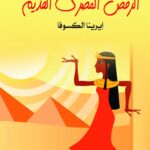
In the book *Ancient Egyptian Dance* by Russian researcher Irina Leksova—the seminal work for all research on dance in ancient Egypt— where the culture of dance emerged, as evidenced by the study of papyri, artistic drawings, and inscriptions on temple walls, which were directly linked to the official religion and the authority of the temple. This contributed to the formation of ancient mythology, as mythological conceptions—as an ancient form of religious consciousness—played an important role in the emergence of rituals and rites and in shaping popular artistic culture. In the summary of the by the aforementioned Egyptian researcher Zainab Muhammad Abd al-Rahim, she considered that the first to lay the foundations for documenting movement art through drawing and also through hieroglyphs was *the ancient Egyptian*.
Ancient Egyptian kinetic art consists of a series of scenes in which the performers attempt to display a wide variety of movements. Men and women performed artistic movements in groups with grace and harmony, and young girls performed artistic movements while playing musical instruments such as the tanbur, the mizmar, the lyre, and the tambourine. while the men always performed artistic movements with vigor and energy, their feet firmly planted on the ground.
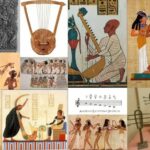
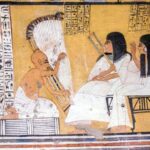
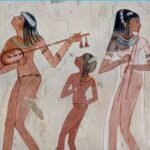
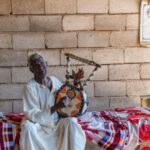
Irina mentioned the types of movement art practiced by the ancient Egyptians:
1. Pure movement art: Initially, the movements were simply an outlet for energy and were irregular; they later evolved into movements with a regular rhythm, shifting from spontaneous to systematic movements.
2. Athletic movement art: This resembles modern gymnastics and acrobatic movement art in the circus, requiring great agility, flexibility, and grace.
3. Musical Movement Art: This is movement art performed with musical ensembles, accompanied by thejingand the flute. It is a type of social dance in which young women sway with grace and charm, executing skillful movements with their arms, torso, and legs while others clap in rhythm. This dance form was performed at parties to entertain guests and also on occasions such as the coronation of a king or the celebration of holidays.
4. Funeral Dance: Many murals depict scenes, expressions, and gestures expressing grief for the deceased, accompanied by various movements. This form is also performed to entertain the spirit of the deceased and ward off evil spirits.
5. Religious Movement Art: In ancient Egypt, movement art was an integral part of religious worship, and the gods took pleasure in the dances.
6. Group Movement Art: Each performer executes movements that differ from those of the others.
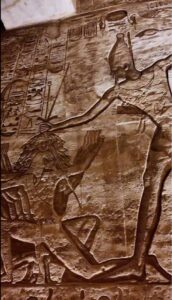
7. Representational Movement Art: Depicted in some murals, where one girl plays the role of the defeated opponent, kneeling, while the other stands holding her left hand; the murals bear the inscription “underfoot,” meaning the performerrepresentingthe king places the defeated one underfoot.
8. Mimetic Movement Art: Performers imitate animal movements, and there are also depictions of natural phenomena, such as a scene on the walls of Bani Hassan inscribed with the word “Wind,” where a standing girl with outstretched arms symbolizes the movement of the wind.
9. Martial Movement Art: A means of entertaining military troops during restperiods,the movement art of soldiers consists of irregular movements accompanied by defiant shouts, with the drummer attempting to direct the dancers’ movements.
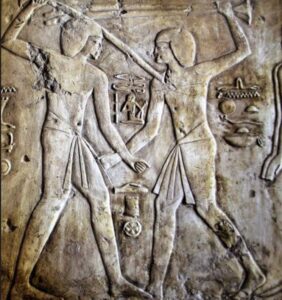
10. Couples’ Movement Art: This is not between a man and a woman as it is today; rather, the pair consists of two men and two women. There are many scenes depicting two girls performing artistic movements in pairs, facing each other, holding hands, each standing on one leg while lifting the other with a bent knee.
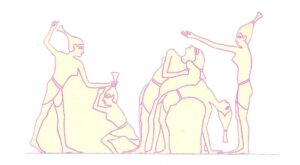
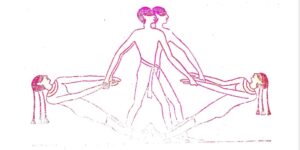
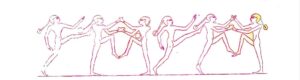
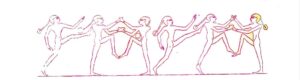
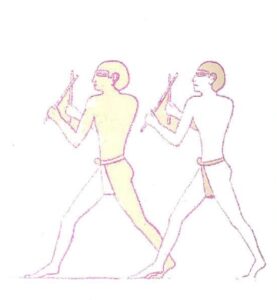
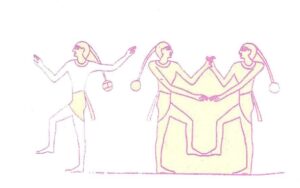
Elements of the art as described by Irina Liksova
Leg movements: stepping – jumping – kneeling
Arm movements: completely free – grasping tree branches – holding hands
- Torso movements: leaning forward – bending backward – bending sideways – twisting the hips, waist, and shoulders
Accessories accompanying the dance: Musical instruments: wind – percussion – string – clappers
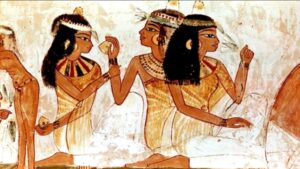
Costumes: Women wore loose white garments open at the front; in some cases, dance murals depict them as having shed their clothes and wearing a piece of cloth around the waist, and sometimes sashes around the chest and waist, as well as bracelets on the hands and feet.
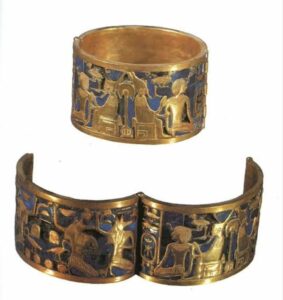
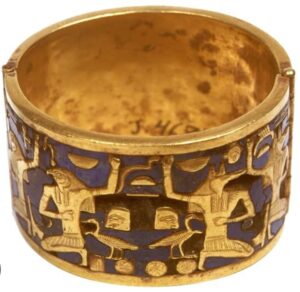
Jewelry: Ancient Egyptian women favored earrings and wide necklaces that covered the chest and shoulders.
Perfume cone: A cone made of a fatty substance saturated with perfume, fixed atop the head; as it melted, it dripped onto the hair, body, and clothing, perfuming the girl or woman.
On January 1, 1990, in *Folk Arts* magazine, writer Louis Baktar wrote in an article titled “Dance in Ancient Egypt”:
“This diversity and variation in movements, costumes, and modes of expression reflect the differing backgrounds of these dances in terms of meaning,
, style, concept, and purpose… that a return to the past is nothing more than an attempt to understand the present… that the connecting thread reflects a degree of continuity and authenticity that deserves to be preserved and nurtured… Perhaps the words of our Egyptian historian “Sami Jabra,” as quoted by “Dreton,” in his book *Pages from the Science of Egyptology*, regarding forms of sacred art still performed in Upper Egypt that carry a long historical legacy, invite us to reflect on our cultural life within its broader historical context. The Egyptian historian told “Dreyton” about a performative art practiced by the people of the villages surrounding the city of Mallawi, based on expressive performance, In it, we can see the historical dimension, as it is based on movements depicting Isis’s lamentations over the body of Osiris and her efforts to revive him. The “Tahatib” dance, for example, bears ancient features that we find in the martial art of stick fighting.
Undoubtedly, many forms of performing arts have been lost over time that could have shed light on the continuity of tradition. Yet, despite the succession of civilizations and cultures throughout Egypt’s history, Egyptian culture in general—and the culture of Egyptian performing arts in particular—has retained its character and distinctive features. Thus, performing arts were preserved and developed solely within the folk environment, and local communities preserved them for centuries, as the tradition was a means of transmitting expertise rather than rigid repetition.
In addition to the changes that have occurred in Egyptian society over the past two centuries as a result of occupation and cultural contact with Western nations, contemporary Egyptian culture has taken on a unique form that expresses ancient Egyptian identity, medieval culture, and modern culture.
Folk performing arts can be categorized, described, and classified based on Egypt’s regional and demographic composition, according to three groups:
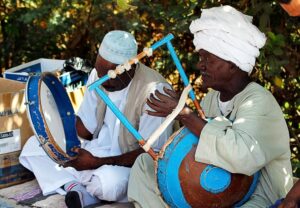
1-* *The Nubians:
who inhabit the southern Nile Valley; their culture was shaped by their work in agriculture, river navigation, certain handicrafts, and the guarding of the southern borders.
They have preserved their styles of folk art thanks to geographical isolation, forced displacement, and their strict adherence to tradition.
2- The Bedouins (Bedouin Environment):
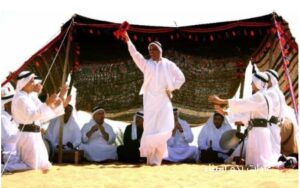
In the east and west, where they arrived from the Arabian Peninsula, we find folk art to be an integral part of their social and daily lives; the arts are transmitted orally and practiced in direct celebratory contexts such as “races, weddings, and equestrian displays,” which embody values, honor, and skill.
3-* *The Nile Valley Region in the Delta and Upper Egypt:
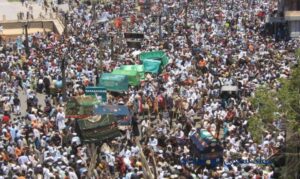
Here, Pharaonic heritage blends with folk traditions, as seen in celebrations of the Nile’s return, Sham El-Nessim, and ancient Mawlid festivals, such as the Mawlid of “Abu Al-Hajjaj” in Luxor.
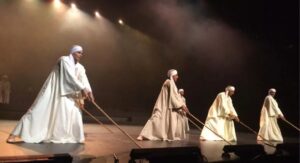
One of the most widespread forms of movement art in popular culture is “Al-Tahteeb,” an art form that embodies the struggle between men who use stick movements to express skill and physical prowess; it is also used for self-defense, and its roots date back to Pharaonic times.
There is also another related form of movement known as “al-Burgas,” which is performed on horseback and is considered a hybrid of movement resulting from the interaction between nomadic and rural cultures.
Folk performing arts can be categorized, described, and classified based on Egypt’s regional and demographic composition, according to three groups:
1-* *The Nubians:
who inhabit the southern Nile Valley; their culture was shaped by their work in agriculture, river navigation, certain handicrafts, and the guarding of the southern borders.
They have preserved their styles of folk art thanks to geographical isolation, forced displacement, and their strict adherence to tradition.
2- The Bedouins (Bedouin Environment):
In the east and west, where they arrived from the Arabian Peninsula, we find folk art to be an integral part of their social and daily lives; the arts are transmitted orally and practiced in direct celebratory contexts such as “races, weddings, and equestrian displays,” which embody values, honor, and skill.
3-* *The Nile Valley Region in the Delta and Upper Egypt:
Here, Pharaonic heritage blends with folk traditions, as seen in celebrations of the Nile’s return, Sham El-Nessim, and ancient Mawlid festivals, such as the Mawlid of “Abu Al-Hajjaj” in Luxor.
One of the most widespread forms of movement art in popular culture is “Al-Tahteeb,” an art form that embodies the struggle between men who use stick movements to express skill and physical prowess; it is also used for self-defense, and its roots date back to Pharaonic times.
There is also another related form of movement known as “al-Burgas,” which is performed on horseback and is considered a hybrid of movement resulting from the interaction between nomadic and rural cultures.