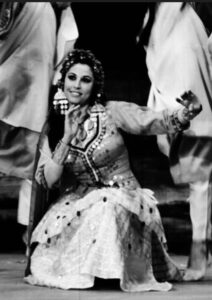
The Rida Troupe Project and the Reinterpretation of Folk Movement Art:
While European and Latin American troupes had been performing on stage since the early 20th century, it became clear
that Egypt possessed a vast, unorganized artistic resource: forms of agricultural and woodcutting movement art, the daily movements of fishermen and farmers, work songs, and celebratory rituals.
In the early 1950s, Mahmoud Reda and his brother Ali Reda attended a performance by the *”Alaria Argentina”* troupe at one of Egypt’s theaters. He subsequently joined the troupe for performances in Cairo, Alexandria, Paris, and Rome, after which he returned to pose his existential and pivotal question: “Why doesn’t the Egyptian express his identity through his own unique movement art?”
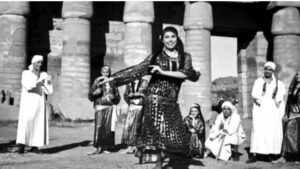
Mahmoud Reda practiced gymnastics and represented Egypt at the 1952 Olympics; studied ballet, and was deeply influenced by Western cinema—meaning his artistic formation stemmed from modernism, not tradition. His modernist sensibility fundamentally shaped his view of folklore; he did not treat it as a static repository to be reproduced as-is, but rather as raw material capable of being reshaped according to the rules of modern theater. so he began a project to reformulate folk movement art not as a social practice but as a performance style. He set out for the villages as a movement artist seeking to extract movements, rhythms, and formations that could be integrated into a theatrical artistic structure, presenting folk movement art for the first time in a disciplined collective form, far removed from the open-ended improvisation that characterizes rural spaces.
In a conscious attempt to change the social structure of the moving body, the first performances took a disciplined form: collective movement arts, modest clothing, a visual composition that prevented the centralization of the female body, and carefully designed movement devoid of any individualistic overtones.
This policy established a new legitimacy for popular movement art within society and a new ethical identity for the performer’s body.
Mahmoud Reda’s project coincided with the rise of the Nasserist movement, and cultural heritage shifted from the hands of the community to those of the official cultural institution, thereby providing an opportunity for folklore to transform from a scattered body of material into a tool for constructing a cohesive national narrative.
Mahmoud Reda’s artistic project aligned with the discourse and orientations of the July Revolution, which promoted folk art by establishing the Center for Folk Arts; thus, the state’s embrace of the troupe’s project was a key factor in its support, effectiveness, and development.
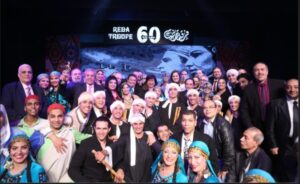
The Rida Troupe began its performances on August 6, 1959, at the Azbakeya Theater (now the National Theater) as a private troupe, and despite its great success, it suffered from financial difficulties. so the Ministry of Culture decided to officially incorporate it in 1961. It represented Egypt at international festivals and was even accompanied by official state delegations, becoming one of the tools of Egyptian diplomacy.
The troupe has presented more than 3,000 performances inside and outside Egypt, Mahmoud Reda traveled across Egypt’s governorates in search of forms of folk movement art, aided by the efforts of state field missions in villages, hamlets, and remote and border regions, where songs, stories, folk movement arts, and various performance styles were recorded. This raw material was then filtered and reworked
to suit the performance’s requirements in terms of timing, rhythm, visual composition, number of performers, and even the nature of movement acceptable on stage.
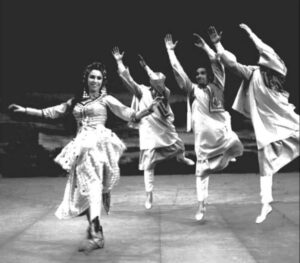
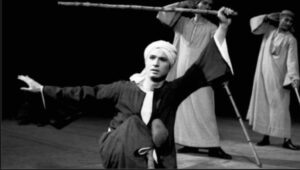
-The Egyptian folklore performances and folk songs presented by the troupe, such as: “The Sweetness of Our Sun,” “Luxor Is Our Homeland,” “The Lemon Dance,” “The Peasants,” “The Cabbage,” “The Alexandrian,” “The Skirt,” “The Firewood Gathering,” and others
These performances were distinguished by their captivating visuals, blending the spirit of Egyptian heritage with a folk atmosphere, and were characterized by the harmony between the performers’ movements and their traditional costumes.
-Ali Ismail, the genius composer who changed the band’s direction and created its distinctive sound,
Reda Troupe a complete artistic identity—sound, rhythm, and structure—recognizable from the very first musical phrase. Ali Ismail had to rebuild music within the folk dance movement itself. He pioneered the most challenging approach to composing music for dance, as it was customary to compose the music first and then design the choreography based on it; however, he decided to reverse the process: Mahmoud Reda would create the choreography first, and then he would compose the music, because he wanted to draw inspiration from the feeling and ensure the music was alive, not just static pieces.
*”Ali Ismail”* formed the first orchestra dedicated to folk arts to accompany the Reda Troupe under his leadership.
Ali Ismail’s music was a reinterpretation of folklore within a modern theatrical framework that balanced popular memory with the demands of the dance performance… He was also an international musician with an Egyptian sensibility.
“A book authored by music critic Dr. Inas Galal El-Din”
Mahmoud Reda did not simply reproduce folklore as it was; he created a hybrid folklore, refined by his talent and vision and suited for the stage.
“Dr. Ahmed Morsi,” professor of folk literature, says: “What performance troupes present is an inspiration drawn from folklore, not folklore itself. According to the scientific definition, the folk heritage must be of unknown authorship, widely circulated, and an expression of the collective consciousness, not an individual vision.”
Dr. Samar Saeed, Dean of the Higher Institute of Folk Arts, says: “Movement art in Egypt has never been a single national art form, but rather a geographical mosaic that is difficult to reduce to a single form, which means that every troupe carries a part of Egypt’s social map.”
Despite any scientific reservations, the Reda Troupe’s artistic project represented a monumental shift that benefited documentation and systematic training, ensuring the survival of certain forms that might otherwise have disappeared, and making folk arts accessible to a wider audience. According to the “Maazif” website and an article by writer and researcher Mervat Al-Fakhrani (The Egyptian Dance from the Reda Troupe to Luxor), she states: “Thus, a new heritage was born within the theater—refined, organized, and reengineered—a heritage that cannot be considered entirely fake, nor purely authentic, but rather a middle ground between memory and performance. This hybrid project remains one of the most significant transformations in the history of contemporary Egyptian performing arts.” sdfgas’lasdfasdf