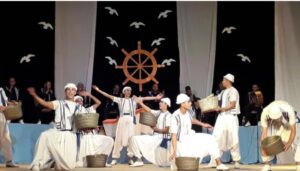
The Port Said National Folk Arts Troupe
is considered one of the most important folk art groups in Egypt because it successfully conveyed the spirit of the coastal city of Port Said with all its details: the sea, fishermen, bamboutiya traders, the simsimiyya instrument, and the life of the Canal people. The troupe has a very distinctive style compared to any other folk troupe because its performances are more connected to port and sea culture rather than rural or Upper Egyptian traditions.
The troupe was established in 1964 and is affiliated with the General Authority for Cultural Palaces. It emerged during a period of strong interest in preserving Egyptian folk heritage after the success of the Reda Folklore Troupe.
The main goal of the Port Said Troupe was to document Port Said’s heritage, represent the Canal cities’ environment on stage, and preserve the art of simsimiyya music and the “Damma” gatherings.
The most important element of the troupe: the Simsimiyya
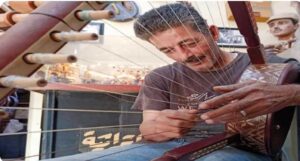
The simsimiyya instrument is the soul of the troupe. It is a string instrument that is extremely famous in Port Said and the Canal cities, and it was closely associated with fishermen, Damma gatherings, and resistance songs after the Tripartite Aggression and the 1967 defeat.
The Damma is a popular folk singing style famous in Port Said, Suez, and Ismailia. It consists of groups of people singing collectively accompanied by the simsimiyya and vocal responses.
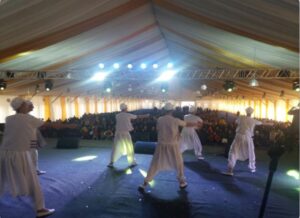
The Port Said Troupe transferred the Damma from the streets and popular cafés to theatrical stage performances.
Among the most famous dances and performances presented by the troupe are:
• El Bamboutiya
• El Sayad (The Fisherman)
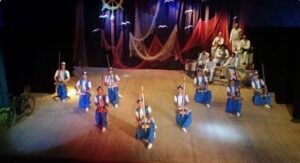
• El Bahariya (The Sailors)
• El Damma
• Om El Kholoul
• Betghanny Le Meen
• Ya Teir Ya Ramady
• Ah Ya Lally
• Yalla Ya Bahariya
• Ehna El بورسعيدية (We Are the People of Port Said)
El Bamboutiya
The Bambouti was the person who used to sell goods to foreign ships in the Suez Canal and the port.
The performance embodies the movement of selling, calling out to sailors, and the joyful atmosphere among the boats.
El Sayad (The Fisherman)
This performance focuses on:
Fishing movements
Pulling fishing nets
The hardship of sailors
Collective cooperation
Its movements resemble the motion of waves and fishing nets.
El Bahariya (The Sailors)
A performance full of movement and energy, expressing:
The life of sailors
Travel
The harbor
Sea songs
The costumes are inspired by the real clothing of the people of Port Said:
Marine galabiyas
Fishermen’s clothing
The Port Said shawl
Tarbooshes sometimes
Sea colors, white, and blue
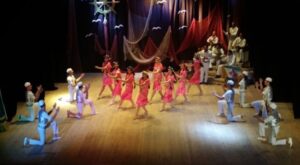
As for the women’s costumes, they are inspired by:
• Port Said women
• Canal cities clothing
• Port fashion styles
Port Said is historically connected to resistance against الاحتلال after the Tripartite Aggression in 1956, and this was reflected in its folk art.
Many of the troupe’s songs contain:
A patriotic spirit
Pride in the city
Collective enthusiasm
Glorification of the Canal people
El Bamboutiya is considered one of the most prominent folk symbols associated with Port Said and the Canal cities in general, as it represents an important aspect of maritime heritage and Egyptian folk identity, and was not merely a traditional profession. Over time, Bamboutiya became an artistic element featured in songs and performances presented by the Port Said National Folk Arts Troupe.
As for the origin of the word “Bambouti,” there are several interpretations. One of the most famous suggests that it was derived from foreign words such as “Boatman” or “Bombote,” due to the continuous interaction between port residents, sailors, and foreigners crossing the Suez Canal. Over time, the word evolved in popular dialect until it came to be pronounced as “Bambouti.”
The Bambouti was known as the person who approached ships using small boats in order to sell a variety of products to sailors, including cigarettes, perfumes, fabrics, souvenirs, as well as food, drinks, and local Egyptian products.
After the opening of the Suez Canal, the canal became one of the most important trade routes in the world, and the Bamboutiya became an essential part of the daily life connected to the port and ship movement. Over time, this popular character gained wide fame, to the extent that many foreign travelers and writers mentioned it in their memoirs as a unique symbol of Port Said and a voice representing the atmosphere of the popular harbor.
During periods of wars and crises, especially during the Tripartite Aggression and later the 1967 war and the closure of the canal, the Bamboutiya profession suffered a major decline due to the halt of ship traffic. Nevertheless, the people of Port Said remained attached to it as part of the city’s heritage and a symbol of popular resilience and resistance.